
Service-Learning Overview
What is Service-Learning by Magnified Giving?
Magnified Giving was founded in 2008 with the mission to educate, inspire and engage students in philanthropy, and to touch the hearts and minds of teens, lighten the concerns of others, and magnify the impact of philanthropy. One way we achieve our mission is by providing resources for service-learning, an approach to teaching and learning in which students use academic and civic knowledge and skills to address genuine community needs while achieving academic standards. The 6 Steps of the Magnified Giving Youth Philanthropy Program align with the service-learning process, so a deeper understanding of service-learning only increases the robustness of your philanthropy education practice. We offer training and resources on this educational approach not only to teachers who facilitate the Magnified Giving program, but to all educators and families in our region, because we know that this approach leads to greater engagement in service and problem-solving!
In 2018, the Mayerson Foundation passed on elements of their transformative Mayerson Service-Learning Program to Magnified Giving in order to continue the meaningful role of providing service-learning resources to teachers and community members. We are honored to continue this critical work to keep our community engaged in service, and we are thankful to be part of The Mayerson Foundation’s legacy of successful empowerment through service-learning.
What is Service-Learning?
The hyphen is important WHY? It represents the balance between service activities (volunteering) and learning goals. Service-learning can be linked directly to curricular standards.
Among other things, it is an exciting practice for learners of all ages that is all about doing. It is not characterized by a project or specific academic discipline. Instead, it is learning brought alive through the process of inquiry. When students participate in service-learning, they move beyond the classroom into the community and use their knowledge and skills to benefit others. Simply put, they serve and they learn — and, in so doing, they become leaders.
What Makes Service-Learning powerful?
Is Personally-Relevant - youth have buy-in
Links to Curriculum - the experience directly ties educational standards
Includes Reflection - time to digest and understand what they are learning and how it matters
Promotes Diversity & Empathy - The work is inclusive
Empowers Youth Voice - This is not another project being directed at them instead planned WITH them
Builds Community Partnerships - Incorporates the needs of the community
Allows for Progress Monitoring - Allows for assessment of progress and understanding
Has Adequate Duration & Intensity - Not a one-time event; a full lesson or academic quarter
Meaningful Service - Has ties to a need - local, state, national and/or global
Benefits to Anticipate for youth participating in Service-Learning
-
Academics and Real Life
When students address a community need, it transforms their learning from two to three dimensions. All aspects of their education have the opportunity to come to life through projects dealing with issues youth identify within their community such as mental health, social justice, education, environment, and poverty or hunger - just to identify a few. Issues they can directly relate to in their community and lives.
Voice and Power
Service-learning helps students find and use their voices. Students investigate, plan, and provide service, then reflect on the outcome. Such responsibility changes their views of themselves and of the world. It shows them that every effort to help others helps themselves as well. The work itself increases their faith and confidence in themselves.
-
Academics and Real Life
Teachers often themselves struggle to answer the question: “Why do we need to know this?” Service-learning is an educational pathway to help answer that question. It gives teachers and students alike renewed purpose when investigation and action is applied to the subject. Experiential and project based learning takes place through service-learning which increase the educational impact.
Role and Purpose
Often teaching feels like it is done in isolation. Service-learning helps to bring youth, families, and communities together. It illustrates teachers’ vital roles in the development of an informed citizens.
-
Students’ Passions and Innovations
Communities get to experience the strength and ability of young people in their community. Youth are our future and service-learning allows the community to experience first hand the skills and passions they have to work towards a stronger community.
Community Partners’ Roles in Schools
In service-learning, a potential partner is anyone in a position to help students and teachers address a community issue. Partners may be from organizations that are already addressing the community need, such as environmental groups, police, other youth, or nonprofit organizations. They might be members of a group that is in need of support or a cause looking for volunteers. Or they might be parents or residents of the community willing to contribute time, materials, or expertise.
Magnified Giving Programs
Magnified Giving utilizes service-learning as a method of instruction while providing an opportunity for students to explore the concept of becoming a philanthropist, now. Students learn to use their time and talent to serve their community and award a $1,000 grant to a local 501(c)(3) nonprofit provided by Magnified Giving.
-
Schools are offering Magnified Giving across an entire grade-level which allows the program to reach all students the school through one single subject, often allowing for curriculum crossover in other subjects in teaching teams. This process permits a school to magnify the impact on the students and the school culture by allowing, within multiple classrooms, a cross-education regarding the social cause selected and nonprofit agencies researched.
-
Schools are offering Magnified Giving across an entire grade-level which allows the program to reach all students the school through one single subject, often allowing for curriculum crossover in other subjects in teaching teams. This process permits a school to magnify the impact on the students and the school culture by allowing, within multiple classrooms, a cross-education regarding the social cause selected and nonprofit agencies researched.
-
Magnified Giving programs can be implemented in core-curriculum courses or in an elective. Regardless of the subject, the real-world connection of the program allows for students to gain skills and apply knowledge as they explore how our communities work. Teachers guide students, empowering them to follow their passions while meeting benchmarks throughout a unit, semester, or year-long program.
-
A Magnified Giving program within an extracurricular club allows the school to design the flow of the program to best fit the culture of their school, and open to a wide variety of students. The Magnified Giving program is implemented in Key Club, National Honor Society, or as a separate Philanthropy Club, or extracurricular activities offered to students. We also encourage student led-initiative programs and only ask for adult support to help keep the process moving forward as needed.
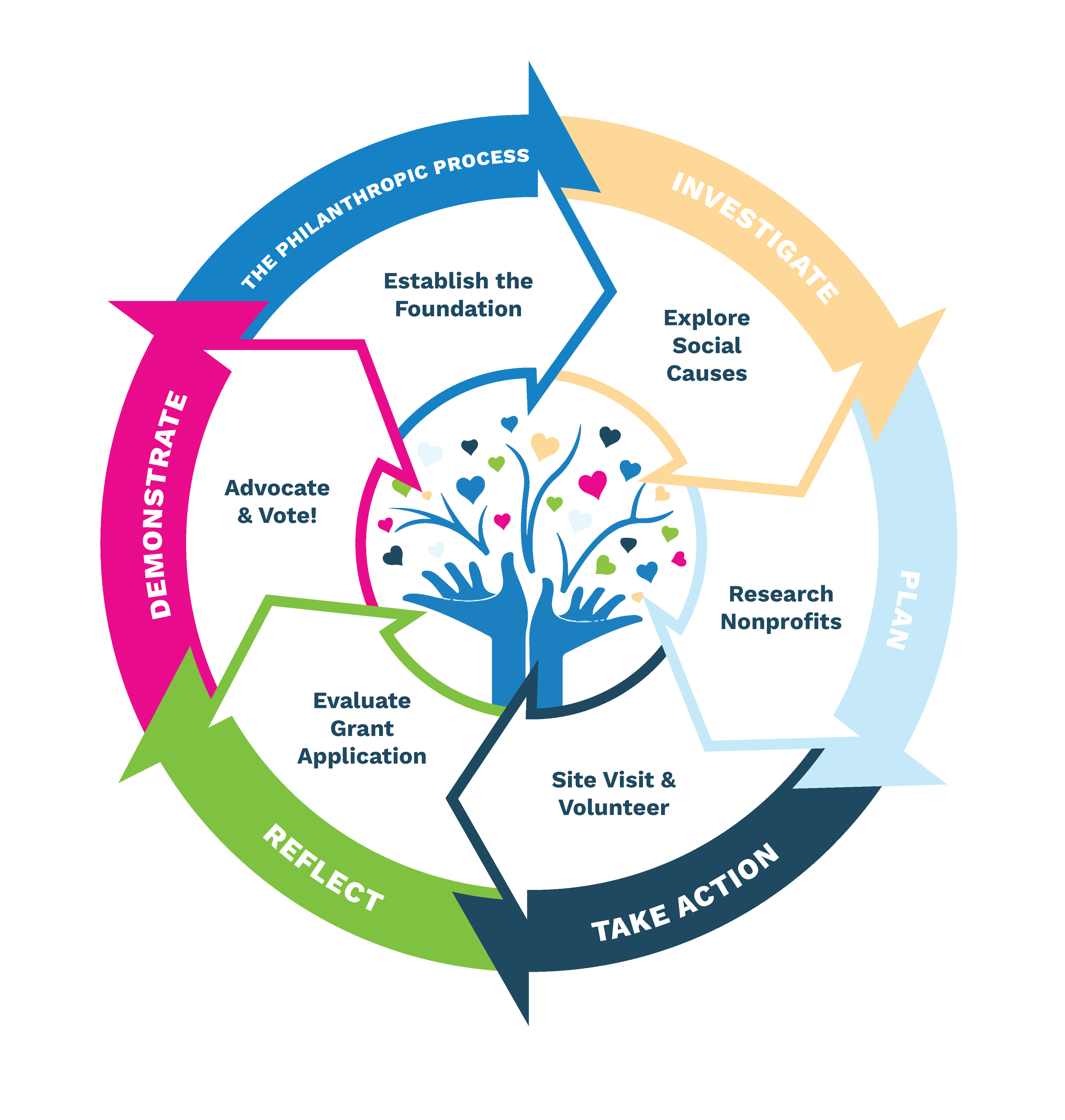
By facilitating Youth Philanthropy Programs and supporting strong service-learning practices, we empower youth to:
Explore social issues that matter to them.
Engage with nonprofit organizations, volunteering, or conducting a site visit to find out more about their mission and why the work they do is essential to their community.
Use their voice to advocate and vote for one or more nonprofits to receive grant funds based on what they learned from their grant application and personal experience.
Understand Impact by asking the nonprofit organization to submit a grant proposal for $1,000 or more if the students choose to fundraise additional funds, as well as the value of volunteering or advocating for an organization or social cause. Analyze what impact their grant could make to that organization.
Reflect on why their actions matter and what the youth philanthropy experience means to them, the nonprofit organizations, and the community.
Celebrate the learning process and award the $1,000 grant to the 501(c)(3) nonprofit organization at the annual Giving Ceremony events.
We do this through a six-step program implemented by teachers that connect donors, students, teachers, and nonprofit organizations.
